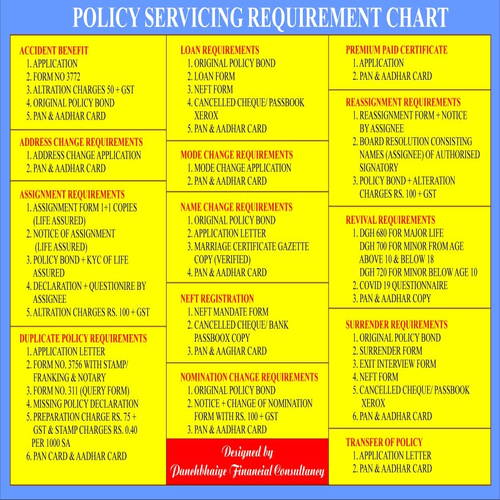
Following Documents Required for Policy Update or Servicing
Form 121 (formerly 15G/15H) is a self-declaration to avoid TDS on interest, dividends, or EPF withdrawals, submitted directly to the payer (e.g., bank, EPFO). Fill Part A with PAN, estimated income, and tax details. Submit via the payer's online portal or download from the Income Tax Department website. [1, 2]
Key Steps to Fill Form 121 (2026-27)
Obtain the Form: Download Form 121 from the Income Tax website. https://www.incometaxindia.gov.in
Fill Part A (Applicant Details):
Name & PAN: Enter valid PAN (mandatory).
Status/Address: Residential status, address, email, and mobile number.
Nature of Income: Specify (e.g., interest, dividend) and total estimated income for the year.
ITR Details: As a new requirement, provide ITR acknowledgement numbers for the last 2 years.
Ensure Eligibility: Confirm your total estimated income does not exceed the maximum exemption limit.
Submit to Payer: Submit the form to your bank, company, or financial institution to prevent TDS. [1, 2, 3, 4, 5]
https://www.incometaxindia.gov.in
Documents Required
Valid PAN (mandatory).
Aadhaar card.
Estimated income/investment details (Form 16/salary slips).
Bank statements/interest certificates. [1, 2]
https://www.incometaxindia.gov.in
Note: Submission of this form does not make income tax-free, it only prevents TDS deduction if total taxable income is below the threshold. [1]
The Census of India 2027 has introduced a digital-first approach, allowing households to complete their registration online. This process, known as Self-Enumeration (SE), is designed to be convenient, secure, and efficient. If you are planning to register your household, follow this step-by-step guide to ensure your data is submitted correctly.
Self - Enumeration Procedure
SECTION 1: Access and Initial Registration
Please note that the portal is active daily from 6:00 AM to 12:00 Midnight.
• Household Details: Enter the Name of the Head of Household.
Note: The Name of the Head of Household cannot be changed once the registration is initiated.
• Contact Information: Enter your 10-digit Mobile Number and an optional Email ID.
o Rule: Only one mobile number can be used per household. Once registered, this number cannot be used for any other household registration.
SECTION 2: Verification and Location Identification
After the initial registration, you must verify your identity and pin-point your residence on the digital map.
• Language Selection: Select your preferred language for the questionnaire.
o Warning: The selected language cannot be changed later in the process.
• OTP Verification: Enter the OTP sent to your registered mobile number to verify your session.
• Address Details: Select your District and enter your PIN code, Village, Town, or Locality.
• Map Marker: Drag the Red Marker on the interactive map to identify the exact location of your residential building and click "Confirm Location."
SECTION 3: Data Entry and Final Submission
In this final phase, you will provide the specific details required for the housing census.
• Completing the Questionnaire: Fill out the Housing Census Questionnaire. You can use the built-in Tooltips, FAQs, and "Essential Information" notes if you have questions about specific fields (such as floor material, drinking water sources, or ownership status).
• Preview and Edit: Use the Preview Screen to review all entered data. You may edit entries or save a draft to submit at a later time.
• Final Submission: Once you are satisfied with the accuracy of your data, click "Submit."
o Crucial: No changes can be made to your data after the Final Submission.
Post-Submission: The SE ID
Upon successful submission, a unique 17-digit SE ID (prefixed with the letter 'H') will be generated. This ID will be sent to you via SMS and Email (if provided).
What to do when an Enumerator visits?
When a Census Enumerator visits your home, simply share your SE ID with them.
• ID Match: If the SE ID matches the existing digital record, your details are confirmed and the process is complete.
• No Match: If the ID does not match, the Enumerator will collect the data afresh to ensure your household is correctly recorded.
Stay Updated: For state-wise self-enumeration periods, please check the "SE Period" section on the official portal to ensure you complete your registration before the deadline.
The Reserve Bank of India (RBI) recently reduced the repo rate to 5.5%, a step taken to revive economic growth and enhance credit availability. While this move may support borrowing and business activity, it poses a silent challenge to conservative investors especially retirees and those dependent on fixed-income instruments.
As repo rates trend downward, bank fixed deposit (FD) rates and pension returns are also expected to decline, since they’re closely linked. If you're relying on traditional savings tools like FDs or conventional pension plans for your future income, this shift could erode your financial stability over time.
The Silent Threat of Falling Interest Rates
Most investors view fixed deposits and pension plans as "safe" options. While they may be safe in terms of capital protection, they’re not immune to interest rate fluctuations. A falling interest rate environment leads to:
In such a scenario, it’s critical to diversify your retirement corpus and ensure that at least part of your income is protected from future interest rate cuts.
Jeevan Akshay and Jeevan Shanti: Your Shield Against Falling Returns
LIC of India offers two powerful annuity plans "Jeevan Akshay and Jeevan Shanti" that act as lifelong financial shields in uncertain times.
Key Benefits:
Guaranteed Lifetime Income: Once locked in, your income remains stable, irrespective of market or interest rate changes.
Interest Rate Immunity: Your returns are fixed at the time of purchase and are unaffected by falling repo or FD rates.
Trusted Backing: These plans are issued by LIC, India’s most trusted life insurer, with sovereign backing and long-term credibility.
Flexibility: Options for single life, joint life, deferred annuity, and more based on your retirement goals.
Why Act Now?
With further repo rate cuts likely in the near future, delaying your investment could mean locking into lower annuity rates. Acting now allows you to lock in higher lifelong income while current rates are still relatively favorable.
Ready to Take Control of Your Financial Future?
If you're looking for stability in uncertain times, LIC’s Jeevan Akshay and Jeevan Shanti plans offer a reliable, tax-efficient, and stress-free solution for retirement planning.
Feel free to reach out to learn more about how these plans can fit into your financial strategy.

Budget 2025: Key Highlights
Focus: Economic resilience, inclusive growth (poor, youth, farmers, women), MSMEs, startups.
Taxation: No tax up to ₹12 lakh (new regime), relief for higher incomes, simplified slabs/TDS/TCS, higher LRS threshold (₹10 lakh), increased rent TDS threshold (₹6 lakh), no TCS on education loans (up to ₹10 lakh). New tax bill.
Fiscal: FY25 deficit 4.8% GDP, FY26 target 4.4%. ₹28.37 lakh crore tax receipts (FY26 est.), ₹14.82 lakh crore borrowing. ₹10.18 lakh crore capex (FY25 rev.), ₹1.5 lakh crore interest-free loans to states.
Agriculture: Program for low-productivity districts, high-yielding seeds mission, creating sustainable fisheries. Infra: Broadband for schools/healthcare, expanded Udaan, ₹25,000 crore maritime fund, airport/canal projects.
Industry: National Manufacturing Mission, new urea plant, solar/battery ecosystem, footwear/toy schemes, India Post logistics.
Education/Skills: 5 skilling centers, IIT boost, AI centers (₹500 crore), 50,000 tinkering labs.
In every growing society, women are back bone of it and we are proud to say that we play a small part in strengthening the back bone by helping women become financially empowered.
First step of financial empowerment begins when we guide parents to make an investment in their daughter`s name so that she has a corpus to rely upon in case of any misfortune happening or despite it. Every girl today should have some wealth in her name as she reaches adulthood.
Second step we take is to help young women understand why it is important to invest money and save for themselves. With growing economy, more and more private sector jobs are opening up which on one hand is good but it also means no retirement pension from government.
So it`s imperative that every girl has a retirement plan for herself.
Third step is to guide every young man to make their wife nominee in all the investment they make and most importantly involve his wife in all the decisions. Wife should always be aware of any investment made so that in case any of any misfortune, she can handles it on her own and doesn`t have to rely on anyone.
With these three steps we make sure that all the women who come in contact with our firm directly or indirectly have a legacy in her name.
We invite you to be a part of our mission and help us by educating women and making them self-dependent on anything financial. A financially self-dependent woman creates a strong family and society.
Happy Women`s Day!